Todoist Alternative: 7 Apps Worth Switching To in 2026
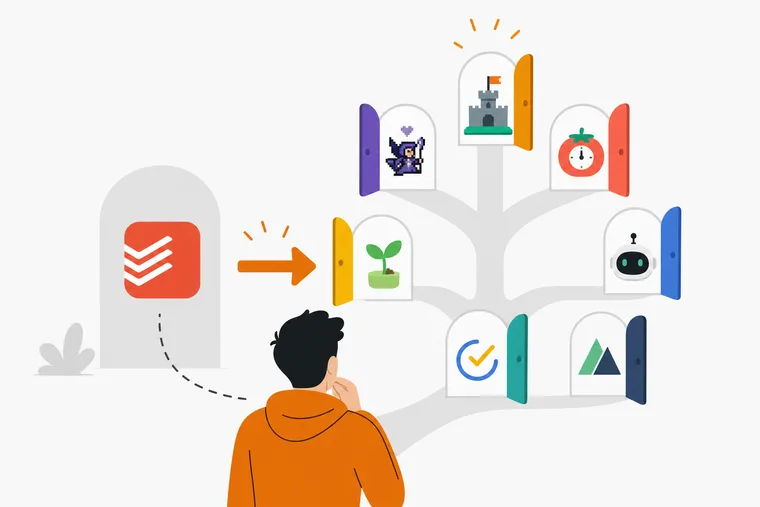
Todoist is a genuinely solid task manager. Clean interface, reliable sync, good keyboard shortcuts. But if you've been using it for a while and something still feels off — no motivation, no focus support, no real reason to open the app — you're not alone. Most people searching for a Todoist alternative in 2026 want one of three things: more gamification, better focus tools, or something that actually connects to their AI coding workflow.
This list covers seven apps worth a real look, with honest notes on who each one suits best.
What Makes a Good Todoist Alternative?
It depends entirely on why you're leaving.
Todoist's strengths are natural language input, project hierarchy, cross-platform reliability and, as of September 2026, an official hosted MCP server at ai.todoist.net/mcp that any MCP-capable assistant can connect to. Its weakness, for a lot of users, is motivational: there's no intrinsic reward for finishing tasks beyond the satisfaction of checking a box. If you're a student, a developer, or anyone who needs external feedback loops to stay consistent, that gap matters more than it sounds.
A strong alternative should cover the basics — due dates, priorities, recurring tasks — and add something Todoist doesn't. Every app below brings a distinct angle.
7 Todoist Alternatives Worth Switching To in 2026
1. Dovilo
Best for: Gamified productivity seekers and AI-native developers who want task management, focus timers, and a visual reward system in one place.
Dovilo takes a different approach to the whole idea of a to-do list. The core loop is simple: complete tasks and focus sessions, earn bricks, spend bricks to grow an isometric city. Every item you finish translates into something visible — a new building, a park, a landmark added to your virtual city.
The task layer covers everything you'd expect: due dates, priorities, categories, and recurring tasks. The Pomodoro-style focus timer awards bricks per session, so focused work and task completion both feed the same reward system. On mobile, it runs on iOS and Android. On desktop (Windows and macOS), the Pro plan adds a built-in MCP server.
That MCP server is what makes Dovilo different for developers. Claude Code, Claude Desktop, Cursor, Windsurf, Codex CLI, Gemini CLI or any MCP client via JSON connects to it and works a separate AI task queue that lives inside a project, with a brief it reads first. My Tasks, your personal list, is not on the tool surface at all, so an agent never sees it. There are nine tools, three read and six write: an agent reads tasks, updates status and logs progress, and cannot create or delete anything. A mobile telemetry view shows agent notes, token usage and cost per task.
Storage is offline-first, so the app works without a network connection. Cloud sync is a Pro feature.
Pricing: The free tier includes full to-do management, unlimited focus sessions, and basic city building with no ads. Pro Yearly is $19.99 per year ($1.67 per month), Pro Monthly is $2.49 per month, and Pro Lifetime is a one-time $49.99 payment. A 7-day free Pro trial is available with no charge if cancelled before it ends.
Where it falls short: The city builder is a reward and visualization layer, not a standalone game. If you want deep RPG mechanics or a large social community, Habitica has more of that. The MCP and AI agent features are Pro and desktop-only.
2. Habitica
Best for: People who want RPG-style gamification with an established community.
Habitica turns your task list into a role-playing game. You build a character, earn gear, join parties with other users, and fight monsters by completing habits and dailies. The community is large and active, and the accountability mechanics — where your party members take damage if you miss a daily — are genuinely effective for some people.
The visual style is retro pixel art, which either feels charming or dated depending on your taste. There's no meaningful focus timer, and no MCP or agent-execution layer. If you're a developer looking for workflow integration, Habitica won't help there.
Where it fits: Students or anyone who responds well to social accountability and RPG progression.
3. TickTick
Best for: Users who want a Todoist-like experience with a built-in Pomodoro timer.
TickTick is probably the closest direct replacement for Todoist on this list. Natural language input, project folders, tags, priority levels, calendar view — it's all there. The built-in Pomodoro timer is a meaningful addition that Todoist doesn't offer natively.
The free tier is more limited than Todoist's, and the Premium plan runs around $35.99 per year. The interface is clean and the mobile apps are well-made. There's no gamification layer and no official MCP server, though TickTick has an open API and community MCP servers.
Where it fits: Power users who want Todoist's feature set plus a focus timer, without significantly changing their workflow.
4. Amazing Marvin
Best for: People with ADHD or complex productivity systems who want deep customization.
Amazing Marvin is built around the idea that no single productivity system works for everyone. You can configure it to behave like GTD, time-blocking, the Ivy Lee method, or a hybrid of all three. The customization depth is genuinely impressive — gamification elements exist, but as optional modules rather than a core identity.
There's no visual reward system and no focus timer built in by default. It's a tool for people who want to engineer their own system rather than adopt someone else's.
Where it fits: Productivity enthusiasts, especially those who've tried multiple systems and want something they can shape precisely.
5. Forest
Best for: People who primarily want a focus timer with a visual reward and a real-world mission.
Forest is a focus timer first. You plant a virtual tree when you start a session; it dies if you leave the app. The app also partners with a tree-planting organization, so your focus sessions contribute to real reforestation.
It's not a task manager. No to-do list, no project management, no AI integration. But if your main complaint about Todoist is that it doesn't support focused work sessions, Forest handles that one thing very well.
Where it fits: Anyone who wants a clean, mission-driven focus timer and doesn't need task management in the same app.
6. Sunsama
Best for: Professionals who want a structured daily planning ritual with calendar integration and AI features.
Sunsama sits at the opposite end of the motivation spectrum from gamified apps. It's calm, structured, and intentional. The daily planning ritual pulls tasks from integrations — Asana, Linear, GitHub, and others — and you schedule them into time blocks for the day. The Pro plan includes AI features and MCP support, which is worth noting for developers who want a planning-first workflow.
At around $20 per user/month billed yearly (as of September 2026), it's one of the more expensive options here. The audience is professionals who want a thoughtful planning process, not a reward system.
Where it fits: People who want structured daily planning with deep calendar and project tool integration, and who have no interest in gamification.
7. BeeDone
Best for: Mobile-first users who want gamified tasks with AI coaching.
BeeDone combines task management with XP, levels, and AI coaching in a mobile-first interface. It's lighter than Habitica in terms of RPG depth but more approachable. There's no persistent world metaphor — you level up a character rather than build something — and pricing isn't publicly listed.
The AI coaching angle is interesting if you want suggestions on how to approach your tasks, though the depth of that feature varies.
Where it fits: Users who want a mobile-first gamified experience with some AI guidance and don't need desktop or agent integration.
How to Choose Between These Apps
The right pick depends on what's actually missing from your Todoist setup.
If you want motivation through visible rewards: Dovilo and Habitica are the strongest options. Dovilo gives you a city to build toward; Habitica gives you a character to develop and a community to stay accountable with.
If you want a near-direct Todoist replacement with more features: TickTick is the easiest transition. The learning curve is minimal and the feature overlap is high.
If you're a developer using AI coding agents: Todoist and Sunsama ship MCP servers too, so agent access is not unusual in 2026. What differs in Dovilo is the shape of it: a local server, an agent-only task queue with your personal list off the tool surface, read and update only, and token and cost telemetry you can watch from your phone.
If you want calm over motivation: Sunsama is the premium option for structured daily planning. It won't gamify your work, but it will help you plan it deliberately.
If focus sessions are your main gap: Forest handles that single job better than most. Dovilo handles it within a broader system.
A Closer Look at Dovilo for Developers
The MCP angle is worth a closer look because it's genuinely new territory for productivity apps.
When you connect Claude Code, Cursor or another MCP client to Dovilo Desktop's local MCP server, the agent sees the AI tasks of the one project it is scoped to and nothing else. It picks up a task, works it step by step, and updates status and notes as it goes. My Tasks is not on the tool surface, so there is nothing to filter and no setting to get wrong.
The mobile telemetry view lets you watch this happen from your phone in real time — agent notes, token usage, and cost per task. If you're running long coding sessions and want to delegate specific subtasks to an agent while you handle others yourself, it's a workflow worth exploring.
Auto-generated JSON config snippets handle the MCP client setup, which cuts down the friction of getting started. The feature is Pro and desktop-only, but at $1.67 per month on the yearly plan — or $49.99 for lifetime access — the barrier to try it is low.
Quick Comparison
| App | Focus Timer | Gamification | AI/MCP Integration | Free Tier |
|---|---|---|---|---|
| Dovilo | Yes (Pomodoro) | City builder | Yes (Pro, desktop) | Yes, no ads |
| Habitica | No | RPG/avatar | No | Yes |
| TickTick | Yes (Pomodoro) | No | No | Limited |
| Amazing Marvin | Optional | Optional modules | No | Trial only |
| Forest | Yes | Visual tree | No | Limited |
| Sunsama | No | No | Yes (Pro) | No |
| BeeDone | No | XP/levels | AI coaching | Unclear |
Frequently Asked Questions
What is the best free Todoist alternative? Dovilo's free tier includes full to-do management, unlimited focus sessions, and basic city building with no ads — one of the more generous free options on this list. Habitica also has a free tier with its full RPG system. TickTick's free plan is more limited.
Which Todoist alternative is best for developers? Dovilo is the strongest option for developers who use AI coding agents. Its built-in MCP server (Pro, desktop) connects to Claude Code, Cursor, Windsurf, and other agents, letting them execute tasks from your list with per-project scope controls and mobile telemetry.
Is there a Todoist alternative with a Pomodoro timer built in? Yes. Both Dovilo and TickTick include built-in Pomodoro-style focus timers. Dovilo ties the timer to a brick reward system that feeds the city builder; TickTick's timer is more straightforward.
What's the cheapest Todoist alternative with Pro features? Dovilo Pro Yearly works out to $1.67 per month ($19.99 per year), which is among the lowest price points for a productivity app with cloud sync, focus timer, gamification, and AI agent integration. The Pro Lifetime option at $49.99 is a one-time payment with no recurring charge.
Is Habitica better than Todoist for motivation? For users who respond to social accountability and RPG progression, Habitica's party system and avatar mechanics can be more motivating than Todoist's plain task list. The trade-off is no focus timer and a more complex interface. Dovilo offers a different gamification model — a city builder rather than an RPG — with a simpler entry point.
Can I use a Todoist alternative offline? Dovilo stores data locally by default and works without a network connection. Cloud sync is available on Pro. Most other apps on this list require a connection for sync, though some cache data locally.
Which Todoist alternative is best for ADHD? Amazing Marvin is specifically designed with ADHD users in mind, offering deep customization of task views and workflows. Dovilo takes a different angle — a focus timer plus a reward you can see — but it is not designed or tested for ADHD, so treat that as a preference rather than a claim. The right choice depends on whether you need customization depth or a visible reward loop.
The Bottom Line
Todoist does a lot of things well, but "well" isn't always enough if you're not opening the app. The best alternative depends on what's actually causing the friction — lack of motivation, missing focus support, or a workflow that doesn't connect to how you work today.
If you want a to-do list that gives you something to build toward, connects to your AI coding agents, and doesn't cost much to try, get it on the App Store or Google Play. The free tier is a solid starting point, and the Pro features — especially the MCP integration for developers — are priced low enough to test properly. It also offers a one-week free trial period.